
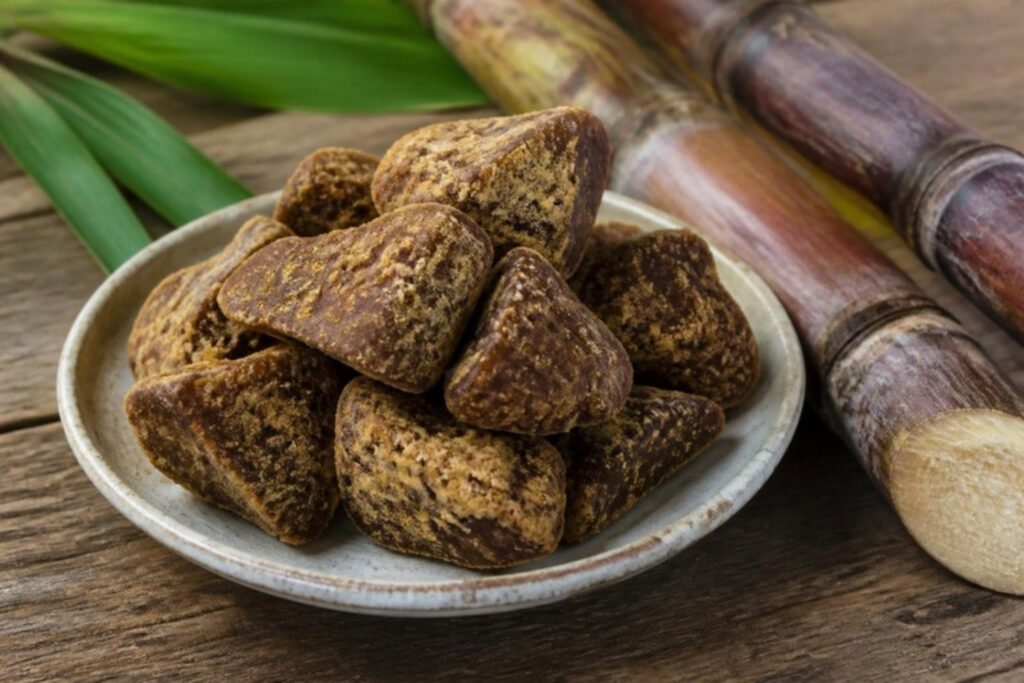
Kokuto (黒糖), the unrefined brown sugar of Amami, is a classic island souvenir. Kokuto shochu (黒糖焼酎), or brown sugar shochu, a distilled spirit made from it, is on the shelf in almost every island izakaya. Both are easy to pick up today, but behind them lies a long history that the people of the islands carried on their shoulders.
Drawing on materials from Kagoshima Prefecture and the Japanese government, this article follows that history from the beginnings of sugar making, through the rule of the Satsuma Domain and the postwar return to Japan, to the reason kokuto shochu became a spirit that can only be made in the Amami Islands.
Information checked: October 9, 2026 (sources are listed at the end of this article)
Timeline of kokuto and kokuto shochu
This timeline is based on the chronology in Kagoshima Prefecture’s “History of Kokuto,” with events related to kokuto shochu added.
| Year | Event |
|---|---|
| 1605 | Sunao Kawachi (直川智) is said to have brought sugarcane growing and kokuto making to Amami |
| 1745 | The Satsuma Domain converts the annual tax into kokuto and has the Amami Islands pay in sugar. Sugarcane growing and kokuto making take off in earnest |
| 1777 | Satsuma imposes the first Sugar General Purchase System of Satsuma (砂糖惣買入制, sato sokaiire: the domain bought up all the kokuto) on Kikaijima, Amami Oshima and Tokunoshima (until 1787) |
| 1830 | Satsuma imposes the second Sugar General Purchase System |
| From 1865 | Satsuma builds four white sugar factories on Amami Oshima. All have stopped operating by 1871 |
| 1878 | Free trade in sugar is allowed in the Amami Islands |
| 1946 | Amami is administratively separated from mainland Japan and placed under US military government |
| 1953 | The Amami Islands return to Japan. Kokuto from the islands can again be sold to Honshu. Kokuto shochu is allowed to be made as a special exception |
| Late Showa era onward | Movements to carry on handmade kokuto arise spontaneously in the Amami Islands |
| 2024 | “Kokuto-making techniques of the Satsunan Islands” (薩南諸島の黒糖製造技術) become a nationally Registered Intangible Folk Cultural Property |
The beginnings of kokuto: Yamatohama in Yamato Village
There are two accounts of how kokuto making began on Amami.
In one, Sunao Kawachi of Yamato Village (大和村) on Amami Oshima set out for Ryukyu, drifted ashore in China, learned sugar making there and came home. In the other, Miwara (三和良), from the same village, went to Ryukyu in 1688 or the following year to learn the technique and started making sugar after returning to the island. According to Kagoshima Prefecture’s materials, the second account has become the more widely accepted one in recent years.
Both accounts agree that it started at Yamatohama (大和浜) in Yamato Village. The village has Hiratomi Shrine (開饒神社), dedicated to Sunao Kawachi. Every year, on the morning of the Hiratomi Festival on the last Sunday of August, people visit the shrine to pray for a good kokuto harvest.
Satsuma and kokuto: “the foremost product of the islands”
When the Edo shogunate restricted sugar imports and encouraged domestic production, Amami, one of the few places in Japan that could make kokuto, became very important.
At the time, the Satsuma Domain (薩摩藩), which ruled the islands from what is now Kagoshima, was close to financial collapse, in part because of the cost of flood-control works on the Kiso River ordered by the shogunate. In an age when sugar was expensive, kokuto was an efficient cash crop. The domain made the islanders pay their annual tax in kokuto instead of rice, and then introduced the Sugar General Purchase System, under which the domain bought up all the island’s kokuto. Kagoshima Prefecture’s materials explain that this placed a heavy burden on the people of Amami, while the success of these financial reforms later helped fund the Shuseikan industrial project and the Meiji Restoration.
Under this system, even the kokuto left over after the required amount had been handed in could not be traded with merchants outside the domain. The prices islanders paid for everyday goods were about 4 to 90 times the Osaka market price. Records show, for example, that getting one koku of rice took about 4.2 to 6.4 times as much sugar as at the Osaka market rate. Materials from the Kagoshima Prefectural Amami Library tell of farmers forced to increase production and living in hardship. This situation has also been called “kokuto jigoku” (黒糖地獄), or “sugar hell.”
Nagoshi Sagenta (名越左源太), a Satsuma samurai who lived on Amami at the end of the Edo period, depicted kokuto making, with cane being pressed and the juice boiled down in pots, in his Nanto Zatsuwa (南島雑話). He wrote that making sugar was “the foremost product of the islands,” and recorded that officials in charge of sugarcane patrolled day and night from the ninth month to the second month of the following year.
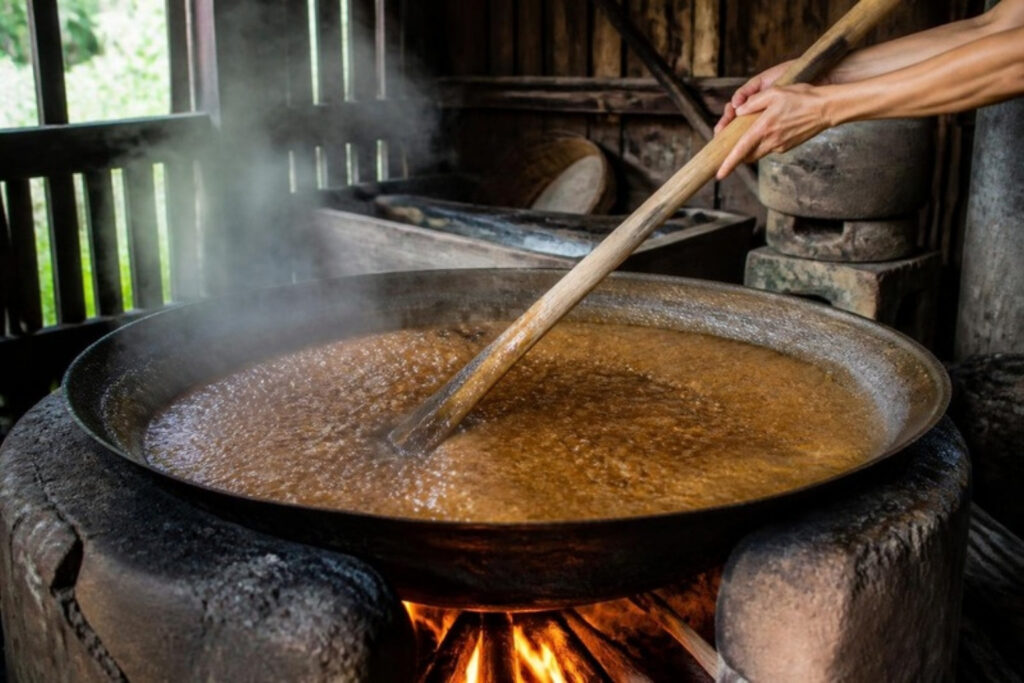
Even under these strict controls, the islanders kept refining their techniques. In 1717, Sabunjin (佐文仁) of Oshima built a waterwheel in the mountains, and waterwheels came to be used alongside cattle and horses to power sugar making. The sugar-making skills built up on Amami were also passed on to other parts of the domain, such as Tanegashima.
The white sugar factories, and kokuto after the Meiji era
At the end of the Edo period, as the price of kokuto fell, the Satsuma Domain planned to make white sugar. It invited British engineers and built Western-style white sugar factories at four places on Amami Oshima: Sedome (瀬留, Tatsugo Town), Kaneku (金久, former Naze City), Suko (須古, Uken Village) and Kuji (久慈, Setouchi Town). But a lack of firewood for fuel and typhoon damage, among other things, meant that every factory closed within a few years. The cut stones from the factories still survive, used in houses and in the stone steps of Naze Elementary School.
In 1878, free trade in sugar was finally allowed in the Amami Islands. This was more than 130 years after kokuto making had taken off under Satsuma’s direction. Even so, the pattern of control did not change overnight in the Meiji era, and for a time Kagoshima Prefecture tried to monopolize kokuto sales through a trading company it set up.
Kokuto in postwar Amami
In 1946, the year after the Pacific War ended, Amami was administratively separated from mainland Japan and placed under American rule. Travel to and from the mainland stopped, goods no longer came in and food shortages became severe. Some people are said to have stowed away to the mainland to sell the islands’ kokuto and buy food.
On December 25, 1953, the Amami Islands returned to Japan, and kokuto from the islands could once again be sold to Honshu. After that, under national policy to increase Japan’s sugar self-sufficiency, many places switched from traditional kokuto making in each village to large factories producing raw sugar for refining into white sugar, and handmade kokuto faced a crisis of survival.
Even so, from around the late Showa era, movements to carry on handmade kokuto arose spontaneously on the islands. And in 2024, “Kokuto-making techniques of the Satsunan Islands” became a nationally Registered Intangible Folk Cultural Property.
The history of kokuto shochu: why it can only be made in the Amami Islands
Secret brewing in the days of Satsuma
According to the Japan Tourism Agency’s multilingual commentary database, kokuto shochu was already being made by the 19th century. The commentary suggests that, in an age when all the harvested kokuto had to be handed over to the domain and islanders were forbidden to use the sugarcane they themselves had grown, people on the islands were making it in secret.
From rice to kokuto
The same commentary says that until the hard years of World War II, awamori, a spirit made from rice, was being produced on Amami Oshima and throughout the Ryukyu islands. A shortage of rice led brewers on Amami to turn to local kokuto, and they went on refining their craft until Amami returned to Japan in 1953.
The return to Japan, and a special exception
At the time of the return, the island’s brewers worried that the high tax rate on alcohol made from sugar would stand in the way of continuing to make kokuto shochu. According to the commentary, the government recognized that the sale of liquor made with kokuto mattered to the island economy and culture, and gave Amami’s brewers special permission to keep making it.
This arrangement continues today. Under a National Tax Agency circular, sugar may be used as an ingredient in single-distilled shochu (honkaku shochu) only when it is made within the jurisdiction of the Oshima Tax Office (Kagoshima Prefecture), and only when it is used together with rice koji. The Oshima Tax Office covers Amami City and Oshima District, in other words, the Amami Islands. That is why kokuto shochu is described as “made only in the Amami Islands” and “made with rice koji.”
Kokuto shochu today
To make it, koji mold converts carbohydrates into sugars, which are fermented; dissolved kokuto is added, and the mash is then distilled. There are now 25 kokuto shochu breweries in the Amami Islands, 10 of them on Amami Oshima. Each brewery has its own approach, such as aging in barrels or earthenware jars, or using kokuto from different producers, and the taste ranges from light to rich and mellow with age.
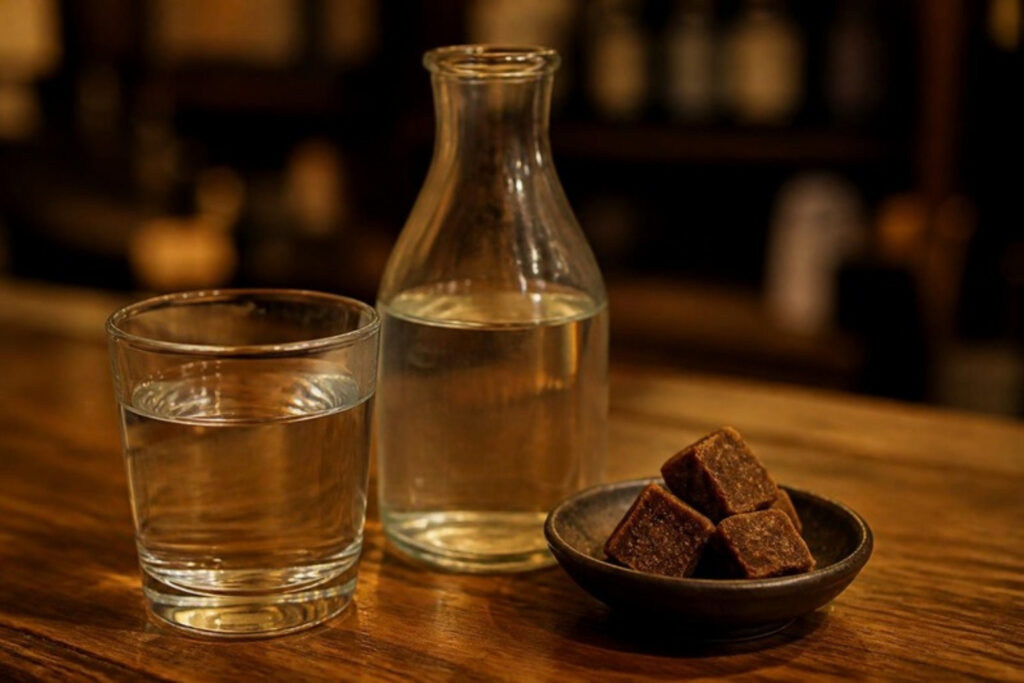
The traditional way to drink it is mixed with room-temperature water. Lately, new ways of drinking it, such as on the rocks or with soda, have been spreading.
Where to learn about kokuto on the island
Kagoshima Prefecture’s materials list the following places on Amami Oshima and Kakeroma Island that introduce the history and tools of kokuto making.
- Amami City Museum (奄美市立博物館, Nagahama-cho, Naze, Amami City): holds the Nanto Zatsuwa
- Amami City Museum of History and Folklore (奄美市歴史民俗資料館, Suno, Kasari-cho, Amami City)
- Kakeroma Island Exhibition and Exchange Center (加計呂麻島展示・体験交流館, in Shodon, Setouchi Town)
- Hiratomi Shrine (開饒神社, Ongachi, Yamato Village): dedicated to Sunao Kawachi. People pray here for a good kokuto harvest at the Hiratomi Festival on the last Sunday of August
Opening days and exhibits can change. Please check each facility’s information before you visit.
A piece of sugar, a glass of shochu
The arrival of sugarcane, the harsh controls of the Satsuma Domain, the failure of the white sugar factories, the postwar separation and the return to Japan. Amami’s kokuto has reflected the history of the islands themselves. Kokuto shochu, too, came through an age of rice shortages and a special exception at the time of the return, and continues today as a spirit that can only be made in the Amami Islands.
When you bite into a piece of kokuto brought home from the island, or order a kokuto shochu with water at an izakaya, think of the long stretch of time behind that piece, or that glass.
Other local dishes and drinks of Amami are introduced in this article:
Amami Oshima Soul Food: Island Dishes and Drinks Beyond Keihan
Sources
(Pages checked on October 9, 2026. All sources are in Japanese.)
- Kagoshima Prefecture, “History of Kokuto” (PDF): chronology, the two accounts of its beginnings, Hiratomi Shrine, why Satsuma had kokuto made, Nanto Zatsuwa, the white sugar factories, the postwar switch to raw sugar, facilities for learning about kokuto https://www.pref.kagoshima.jp/ba08/kokuto/documents/128908_20260617134315-1.pdf
- Kagoshima Prefecture, Kokuto History Column on improving techniques under strict sugar policy (PDF, by Yuki Takehara, Tokunoshima Town history compilation office): waterwheels, the spread of techniques, trade under the Sugar General Purchase System, free trade in 1878 https://www.pref.kagoshima.jp/ba08/kokuto/documents/128908_20260617134239-1.pdf
- Kagoshima Prefectural Amami Library, “History of Amami 3” (Amami FM broadcast script, PDF): purchase of all kokuto in 1830, white sugar factory sites, the Meiji sales monopoly, administrative separation and stowaways, the return on December 25, 1953 Open the PDF
- Ministry of Agriculture, Forestry and Fisheries, “Our Regional Cuisines: Kokuto, Kagoshima”: payment of tax in kokuto, “sugar hell,” large postwar sugar factories https://www.maff.go.jp/j/keikaku/syokubunka/k_ryouri/search_menu/menu/kokuto_kagoshima.html
- Japan Tourism Agency, multilingual commentary database, “Brown Sugar Shochu” (Amami Oshima Tourism and Products Federation, fiscal 2020): origins, from rice to kokuto, the special exception at the return, how it is made, 25 breweries (10 on Amami Oshima), ways of drinking https://www.mlit.go.jp/tagengo-db/R2-00860.html
- National Tax Agency, interpretive circular on the Liquor Tax Act, Part 2, Article 3, item 10: use of sugar as an ingredient in single-distilled shochu https://www.nta.go.jp/law/tsutatsu/kihon/sake/2-02.htm
- National Tax Agency, Oshima Tax Office (jurisdiction: Amami City, Oshima District) https://www.nta.go.jp/about/organization/kumamoto/location/kagoshima/oshima/index.htm


Comments