
Finely shredded chicken, thin strips of egg, dried shiitake mushrooms simmered sweet and savory, green onion, nori seaweed, pickled papaya and citrus peel on a bowl of rice. Over it all goes plenty of hot broth made from chicken bones. This is keihan (鶏飯), the signature local dish of Amami.
It may look like a generous bowl of ochazuke, the Japanese dish of rice with hot tea or broth poured over it, but there are several stories in that one bowl: island life in the Edo period, the way of eating that took shape after the war, and even its popularity in Kagoshima school lunches. Here are five stories that make keihan a little more fun to eat once you know them.
Information checked: October 8, 2026 (sources are listed at the end of this article)
Story 1: It began as a dish for entertaining officials
Keihan goes back to the Edo period (some say about 400 years).
At the time, the Amami Islands were under the rule of the Satsuma Domain (薩摩藩), and the islanders suffered under heavy taxes. Keihan is said to have begun as a way of entertaining the officials who crossed from mainland Kagoshima on inspection, in the hope of softening their attitude even a little.
Chicken was precious then, and using a whole bird made this the finest feast people could manage. The dish is said to pass down the history of people who tried to welcome guests even in hard times.
Story 2: At first it was seasoned rice with no broth
Today, keihan means putting toppings on rice and pouring broth over them, but it was not always this way.
In the beginning, keihan was more like takikomi gohan, rice cooked together with other ingredients, with no broth poured over it. Eating it with hot broth on the rice only spread in the Showa era (from 1926).
The restaurant credited with creating today’s form is Keihan Ganso Minatoya (鶏飯元祖 みなとや), facing Akagina Port (赤木名港) in Kasari-cho, Amami City. This long-established restaurant was founded in 1946, and its first owner, Kine Iwaki (岩城キネ), is said to have reworked the cooked-rice keihan into the style we know today.
Story 3: You finish it yourself
Keihan is a dish you complete yourself, putting the toppings on your own rice and pouring the broth over last. By choosing the toppings and how much of each to use, you can change the flavor with every bowl.
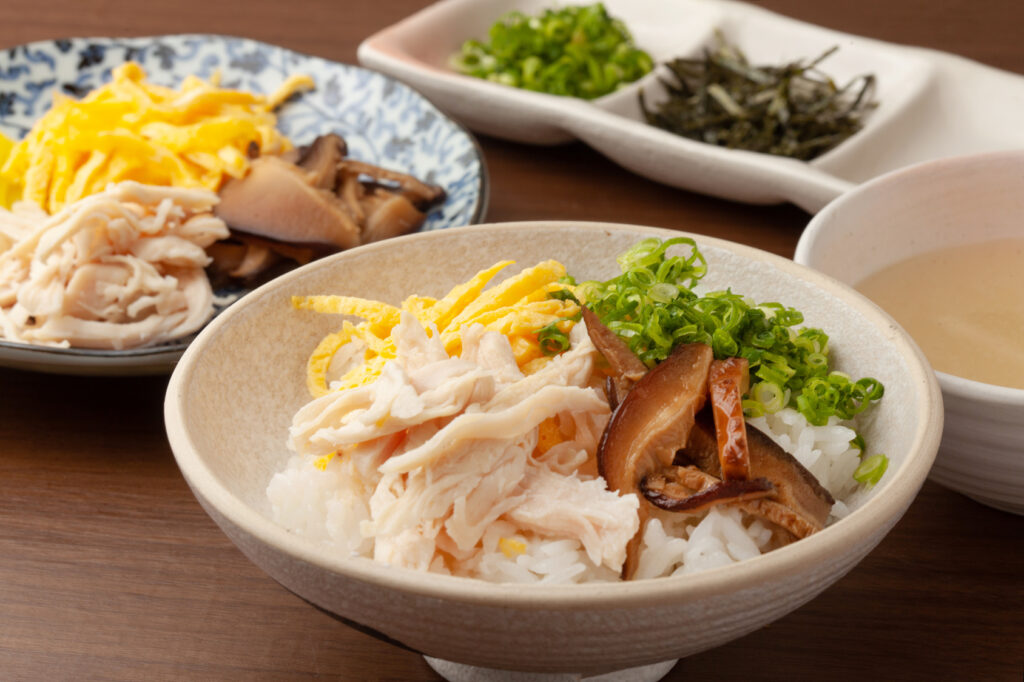
The main toppings are as follows (they vary by restaurant and home).
- Boiled and shredded chicken
- Dried shiitake mushrooms simmered sweet and savory
- Thin strips of egg
- Green onion and nori seaweed
- Papaya pickled in miso
- Peel of mikan or tankan citrus
The miso-pickled papaya and citrus peel are garnishes typical of Amami.
The key to eating it is a little rice and plenty of broth. Part of keihan’s appeal is how lightly it goes down.
Story 4: Second in a national poll, and a favorite in Kagoshima school lunches
Keihan is a popular local dish across Japan.
In fiscal 2007, when the Ministry of Agriculture, Forestry and Fisheries selected its “100 Best Local Dishes,” it ran an online popularity poll for reference. Keihan came second in the country, behind imoni, the taro stew of Yamagata Prefecture.
It is also a familiar dish in Kagoshima Prefecture’s school lunches. A study of the fiscal 2014 menus of 56 facilities in the prefecture found that keihan appeared more often than any other local dish served (172 of 766 appearances, about 22.5%). It was served most often in the months at the start and end of school terms, which suggests it has a place as something of a treat.
Story 5: Easy at home, and spreading as a souvenir
You might expect a traditional local dish to have a fixed recipe, but keihan differs a little from area to area and from home to home.
When making it at home, people sometimes use store-bought chicken stock instead of making broth from bones. There are also sets of broth and toppings, and freeze-dried products, sold as souvenirs. Even away from the island, a chance to taste keihan may be closer than you think.
The stories in one bowl
Keihan looks like simple rice with broth. But that one bowl holds many layers: the Edo-period history of entertaining officials, the way of eating that took shape after the war, and its place today in school lunches.
Keihan should look a little different once you know the background. Which toppings would you choose, and how much of each, to make your own bowl?
Amami Oshima has other dishes and drinks handed down on the island too. They are introduced in this article:
Amami Oshima Soul Food: Island Dishes and Drinks Beyond Keihan
Sources
(All sources are in Japanese.)
- Ministry of Agriculture, Forestry and Fisheries, “Our Regional Cuisines: Keihan, Kagoshima” (origins, the change from cooked rice, main toppings, how to eat it, school lunches and products) https://www.maff.go.jp/j/keikaku/syokubunka/k_ryouri/search_menu/menu/keihan_kagoshima.html
- Ministry of Agriculture, Forestry and Fisheries, “Food Education Navi for Children: Keihan” (origins, heavy taxes and hospitality) https://www.maff.go.jp/j/syokuiku/kodomo_navi/cuisine/cuisine7_7.html
- Kazuyo Chuman and Akiko Otomi, on the use of local cuisine and local produce in Kagoshima school lunches (2), Bulletin of Kagoshima Junshin Junior College, no. 47, 2017 (poll ranking, appearances in school lunches) https://k-junshin.repo.nii.ac.jp/record/589/files/kiyo_47_04.pdf
- Rurubu & more., “Keihan Ganso Minatoya” (year founded, the first owner’s change to today’s form, about 400 years) https://rurubu.jp/andmore/spot/80042046
- Rurubu & more., article on Keihan Hisakura (toppings, garnishes typical of Amami) https://rurubu.jp/andmore/article/15036


Comments