

Shodon (諸鈍) is a village in the east of Kakeroma Island (加計呂麻島), at the head of Shodon Bay.
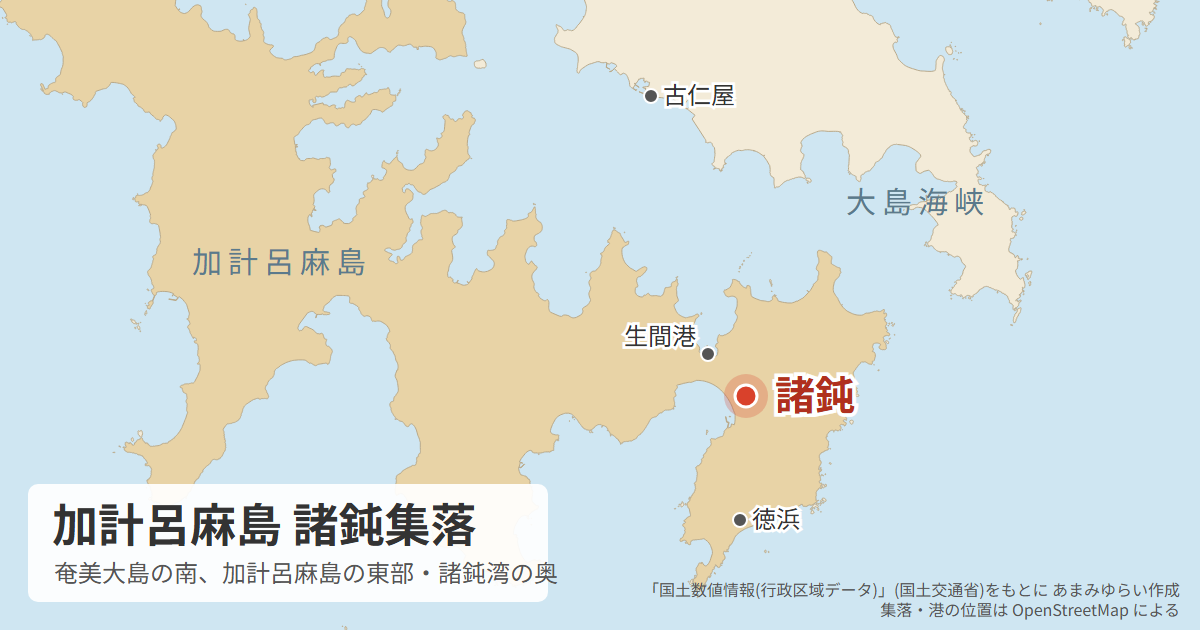
From Ikenma (生間) Port, where the ferry arrives, the road climbs over a pass. The bay comes into view through the trees, and at the bottom of the slope a white beach appears, with a row of deigo (coral trees) lining the shore.
It is the largest village on Kakeroma Island, and “Shodon Shibaya,” designated a National Important Intangible Folk Cultural Property, is still performed here.
Shodon is more than the scenery of its coral tree avenue and long beach. It is a village where the legend of the Heike refugees and the Shibaya play, the sea route that linked the Ryukyu Kingdom with mainland Japan, and memories of island life all overlap.
A bay over the pass, in the east of Kakeroma Island
Shodon is one of the villages of Kakeroma Island, which belongs to Setouchi Town.
In the eastern part of Kakeroma Island, Ikenma Port faces Amami Oshima across the Oshima Strait, while on the south side, beyond the hills, Shodon Bay cuts deep into the land. The village of Shodon sits at the head of that bay.
The ferry from Koniya (古仁屋) to Ikenma Port takes about 20 minutes. From Ikenma Port to Shodon is about 5 minutes on the island bus.
You can also walk from the port. Partway up the gentle slope toward the pass, there are spots where you can see the town of Koniya across the strait.
Today it is a short trip by car or bus, but it was not always so.
According to the account of a woman who lived in Shodon during and after the war, it took 30 minutes to walk the steep mountain path from Shodon to Ikenma. From Ikenma to Koniya, a small motorboat ran once a day and took more than 30 minutes.
Even getting across to Amami Oshima meant first crossing the pass. Life in the village at the head of the bay went hand in hand with journeys like these.
The largest village on Kakeroma Island
In the 2020 national census, the Shodon district had a population of 160 in 92 households, the largest of any district on Kakeroma Island. This figure also includes Tokuhama (徳浜), the village beyond the pass.
The village has a post office, a general store, places to stay and places to eat, as well as the “Kakeroma Island Exhibition and Exchange Center” (加計呂麻島展示・体験交流館), which introduces the island’s history and traditional performing arts.
In front of the shrine there is also a sugar mill that makes kokuto (brown sugar).
Setouchi Town’s archaeological surveys have identified the “Shodon Kuri site,” the “Shodon Kaneku site” and the “Shodon Sato site” within Shodon, and in the hills there is the “Shodon Castle site,” recognized by the prefecture.
Kaneku (金久) means sandy land and sato (里) means a place where houses cluster; both are place names found widely across the Ryukyu Islands. According to a local folklore researcher, while in many villages in Setouchi Town the sato is on the seaward side, Shodon’s sato lies inland, away from the sea, on the hillside.
Sandy land near the beach, and old dwellings on the hillside. The place names of today’s village still carry the layers of a long history of settlement.
The Heike legend and Ochon Shrine
At the entrance to the village, at the bottom of the slope, stands Ochon Shrine (大屯神社).
Amami has many legends that members of the Heike (Taira) clan, defeated at the Battle of Dan-no-ura in 1185, crossed over to the islands.
The story told in Shodon is that Taira no Sukemori (平資盛), a grandson of Taira no Kiyomori, built a castle here and lived out his life in Shodon. It is said that Sukemori sometimes invited local people to his castle, served them sake and showed them performances, deepening his ties with them.
Ochon Shrine enshrines Sukemori, together with Emperor Ojin and Empress Jingu.
The people of the village keep the shrine clean, and it is still carefully looked after.
Shodon Shibaya: a village play performed by men
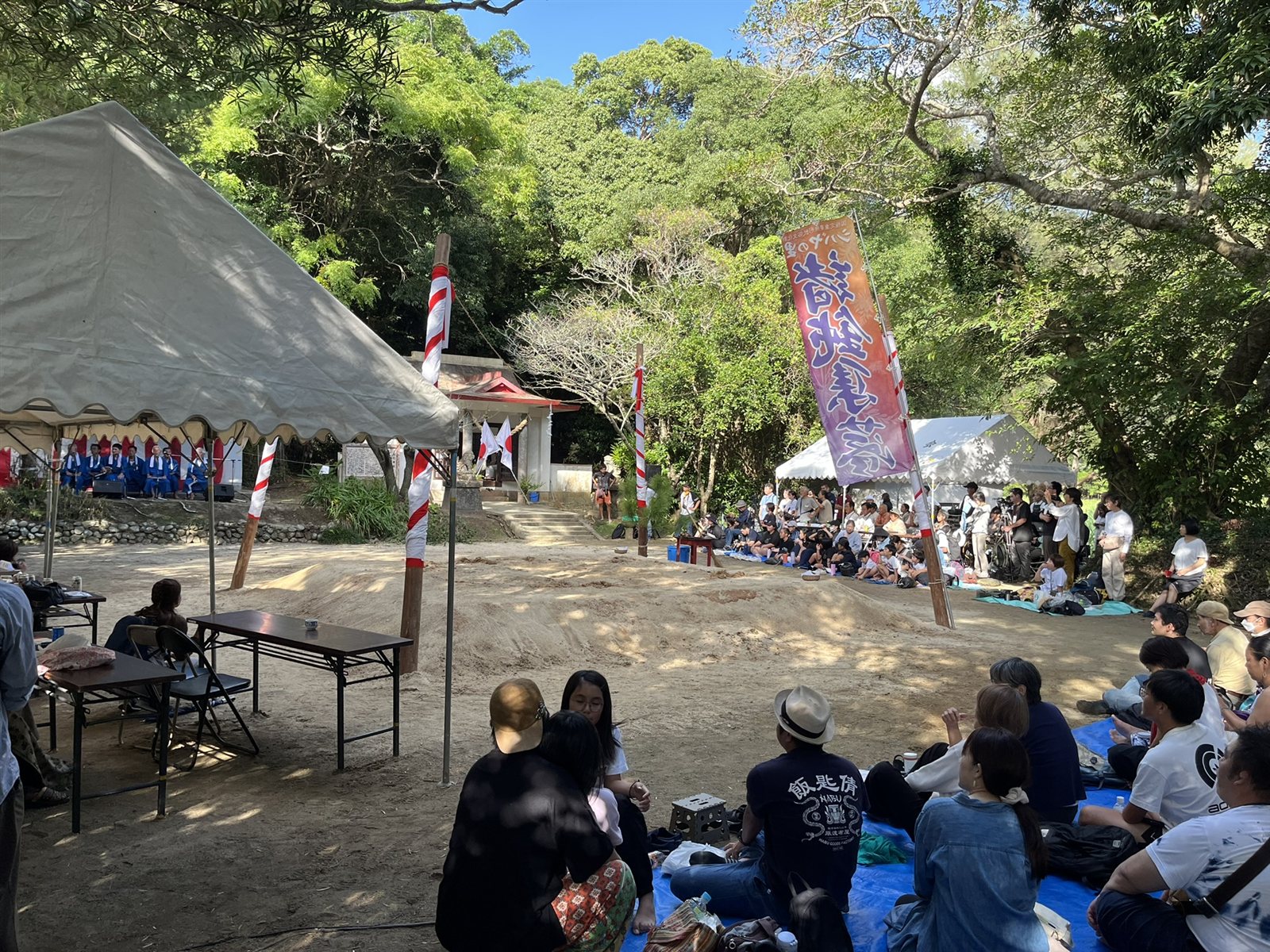
Every year on the ninth day of the ninth lunar month (Kugatsu Kunchi), a festival is held in the grounds of Ochon Shrine, and “Shodon Shibaya” is performed.
It was designated a National Important Intangible Folk Cultural Property in 1976.
The origin of Shibaya is also tied to the legend of Sukemori.
It is said that after Sukemori died, the local people began to perform the arts he had shown them, and this became Shibaya.
However, there are no records to confirm this origin; it remains an old tradition passed down by word of mouth.
There are also two theories about the name “Shibaya.”
One is that it comes from shibai (芝居), “a play” shown to an audience. The other is that the hut used as a dressing room by the performers was enclosed with leafy branches and brushwood (shiba, 柴).
All the performers are men.
They wear handmade paper masks called kabidira (カビディラ) and hats shaped like a warrior’s jingasa, and dance to the shamisen and accompanying music.
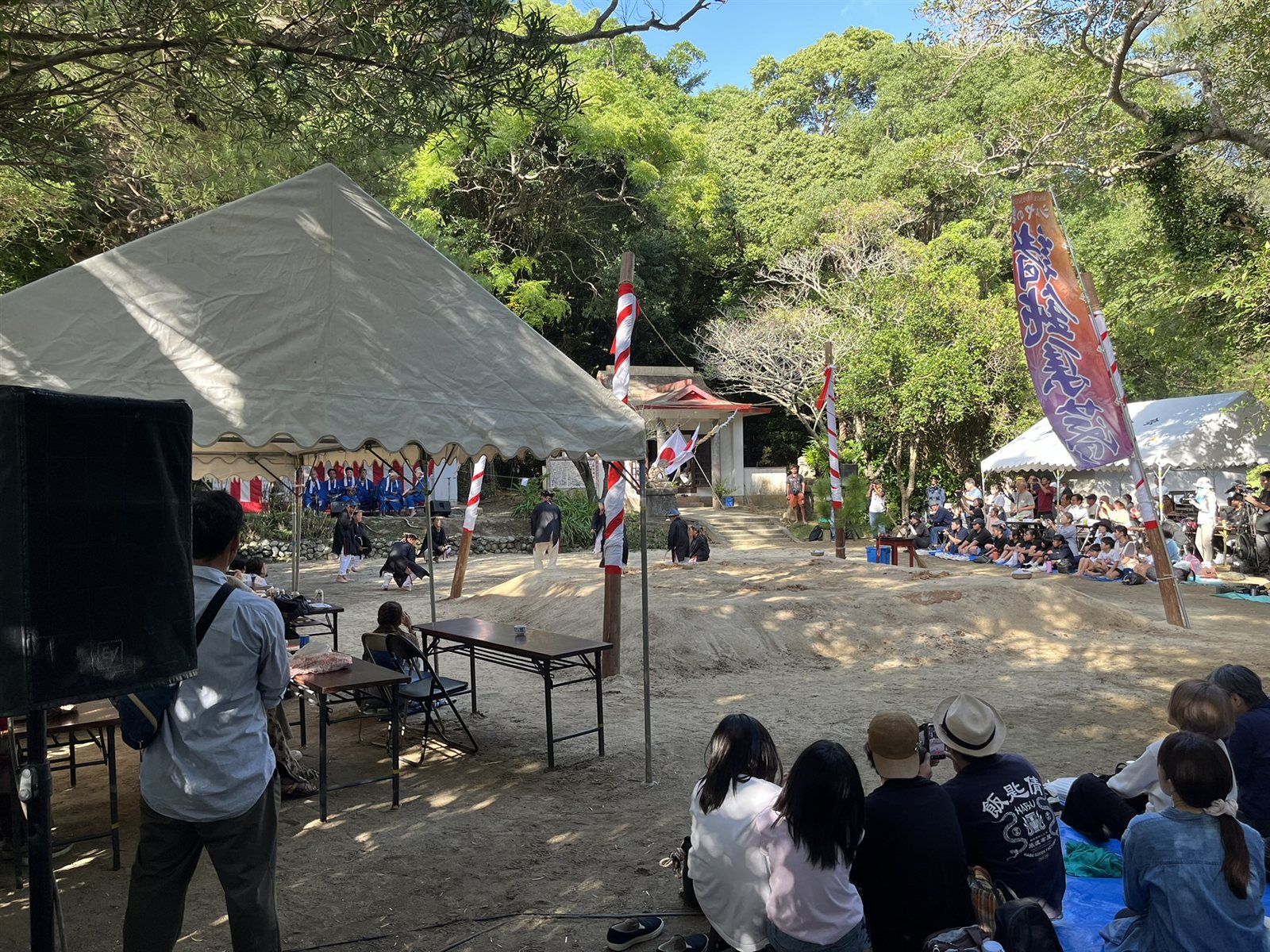
There were once more than 20 pieces in the repertoire. Today 11 are handed down, beginning with “Isso,” the entry into the dressing room, and including “Sanbato,” “Tamatiyu,” “Shishikiri,” “Sukutengwa” and “Kama Odori,” with improvised comic plays and a puppet play among them.
Many of the pieces have three parts, called deha, nakaba and iriha, and Shibaya has attracted attention as a form in which the dances of early kabuki took root in Shodon.
According to the national cultural property record, the performers purify themselves in the sea before heading to the dance ground in the shrine.
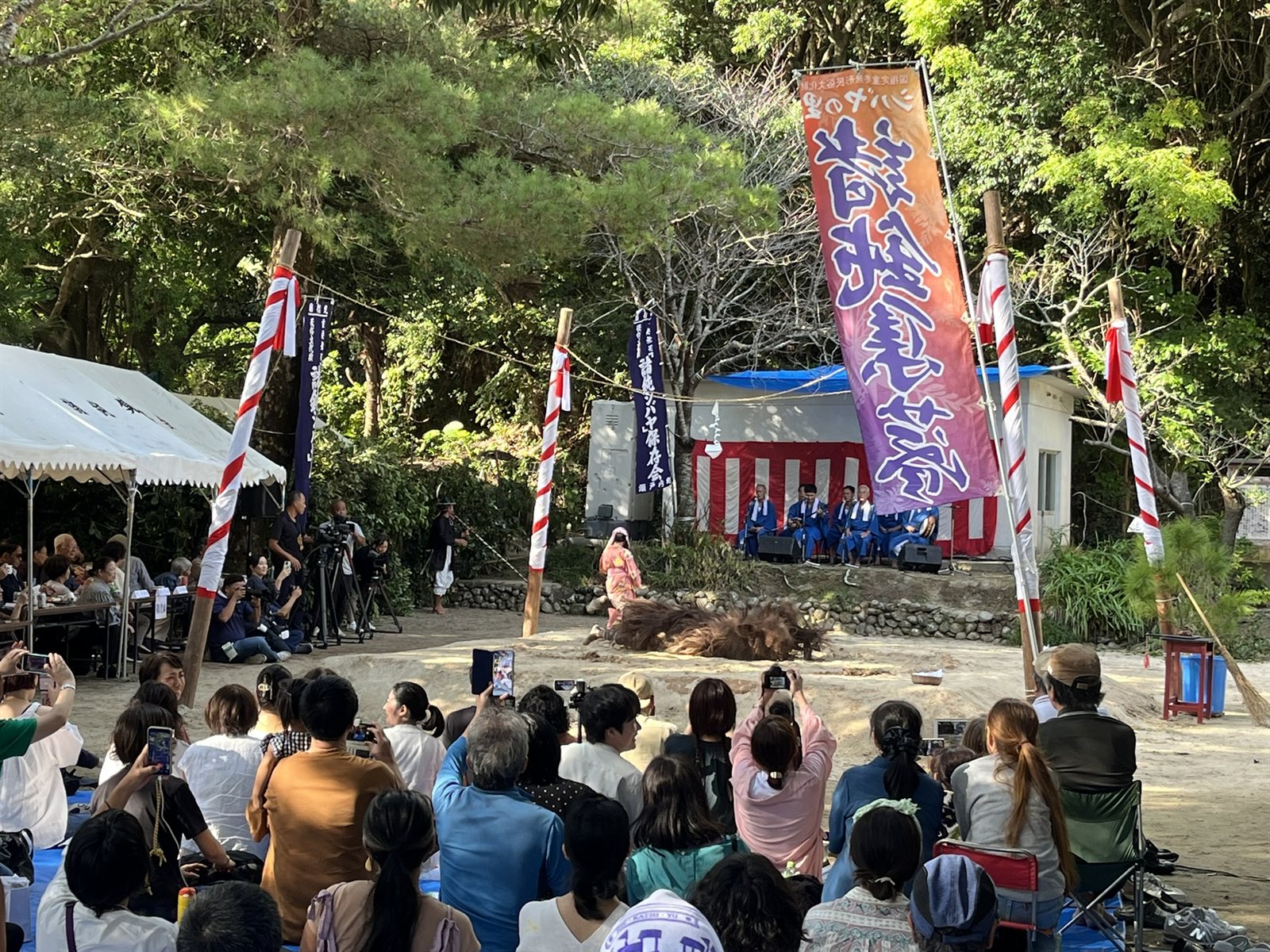
In 2025, the festival fell on October 29, the ninth day of the ninth lunar month. A sumo ring was built in the shrine grounds. According to the program posted at the venue, the opening greetings were followed by the “opening of the ring,” and the program included the performers’ purification in the sea, sumo and dances by elementary and junior high school children, a ring-entering ceremony by the village youth association, and “Chibikko Shibaya” by nursery school children, with Shibaya performed in two parts in between. Near the end came “Rokucho,” a lively Amami dance.
The Shibaya pieces on that program were, in Part 1, “Gakuya-iri,” “Sanbato,” “Kukuwa-bushi,” “Dattodon,” “Kinko-bushi” and “Sukutengwa,” and in Part 2, “Shishikiri,” “Kama Odori,” “Tamatiyu,” “Shinjo-bushi” and “Takaki-yama”: 11 pieces in all.
When the festival was designated in the 1970s, the national record stated that it was “performed at the time of the Jugoya festival (the 15th day of the eighth lunar month),” suggesting that the festival date has also shifted over time.
Shibaya has not continued without interruption.
Around the beginning of the Meiji era, the well-regarded Shibaya toured the villages of Amami Oshima and was also to be performed on Tokunoshima Island. But a major failure there is said to have stopped performances until the early Taisho era, when it was revived at the opening ceremony of Shodon Elementary School.
The second break was from 1943 to 1956, when the hardships and shortages of the war and postwar years meant the props had been lost.
According to a 2012 introduction by the Kagoshima Prefectural Amami Library, by then elementary and junior high school students in the school district were practicing with adults from the preservation society and appearing on stage every year. In the 2025 program, too, “Kinko-bushi” and “Kama Odori” were performed by students of Shodon Elementary and Junior High School.
On the ninth day of the ninth lunar month, many people come to Ochon Shrine to watch, not only those with ties to Shodon but also visitors from off the island.
It is a performing art that the people of the village have kept alive through two interruptions.
The sea route and the coral tree avenue
Along the beach at Shodon runs an avenue of deigo, or coral trees.
The avenue has 85 coral trees, including large ones over 300 years old, and 21 of them are listed in the national survey of giant trees. It was designated a Natural Monument of Setouchi Town in 1978.
It is said that in the days of the Ryukyu Kingdom, the red flowers of the coral trees served as a landmark for this trading port.
There is also a legend that the area around the avenue was once where Ryukyu troops stayed.
Materials compiled by a man who long served as president of the Shibaya preservation society state that Amami lies between mainland Japan and Okinawa, and that Shodon Bay in particular was long an important relay point for north–south sea traffic.
In this view, the Ryukyu culture from the south and the Yamato culture from the north met and blended here, and Shibaya blossomed from that meeting.
The Heike legend, the story of the Ryukyu troops, the coral trees as a landmark. Shodon’s stories always feature people who came from across the sea. The village’s traditions seem to tell us that this port at the head of the bay lay along the sea route between south and north.
The coral trees bloom every year from around late May to early June.
In 2008, however, damage from a tiny wasp that infests coral trees (the erythrina gall wasp) spread to the avenue. The town board of education asked villagers to help, and in December that year sprayed not only the avenue but all the coral trees in the village to protect them.
Tree doctors have been treating the trees, but many of them are over 300 years old, and in recent years it has become difficult for them all to bloom at once.
Even outside the flowering season, the beach lined with great trees welcomes visitors to Shodon.
Shodon Nagahama beach and the house from the movie
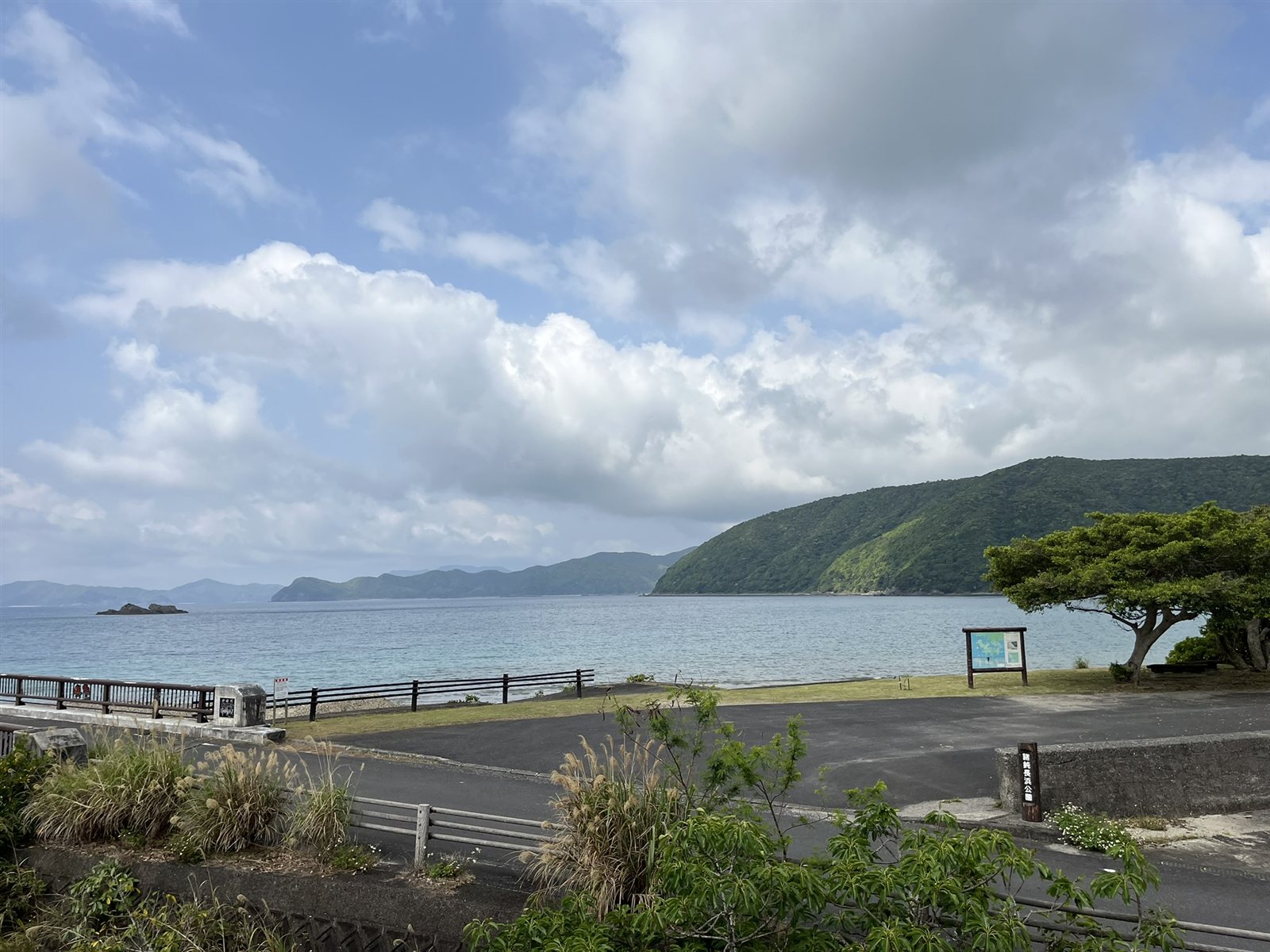
In front of the coral tree avenue stretches Shodon Nagahama, a white sand beach.
The beach has long been sung about in the island folk song “Shodon Nagahama-bushi.”
In Shodon Nagahama Park by the beach stands a monument commemorating the filming of the movie “Otoko wa Tsurai yo: Torajiro Kurenai no Hana” (1995), with lines from the film carved on it.
Along the coral tree avenue is an old house that was used in the film as the home of Tora-san and Lily. It stood empty for a long time, but it has since been restored and is now a whole-house rental.
Tokuhama Beach, beyond the pass, was also a location for the same film.
Memories of daily life: “iiwaku” and the “toriage baasan”
Shodon has also been a subject of academic research.
The Shodon dialect has been studied by linguists since the 1970s. Kanehisa Tadashi (金久正), who wrote that the word miya (ミャー, the open ground used for village festivals) is a variation of miya (宮, shrine), was also from Shodon.
The account of a woman in her 80s who had lived in Shodon, recorded in interviews in 2008, has been published in a medical journal. It describes daily life and childbirth during and after the war.
According to her account, there were no midwives or obstetricians on Kakeroma Island at the time, and giving birth at home was the norm. There was one midwife in Koniya, but because of the cost of the delivery and the boat fare, almost no one went there.
Births were assisted by experienced female relatives and neighbors, known as “toriage baasan” (birth grannies).
She also recalled the word “iiwaku,” used for work that everyone did together, such as rice planting. It means helping and supporting one another.
Kakeroma Island, facing the Oshima Strait, was an important navy base during the war. Every village suffered war damage, and food was rationed. These are stories from a time when people got by on sweet potatoes, vegetables and fish from the sea.
This is the account of one woman, and life was not necessarily the same everywhere on Kakeroma Island.
Even so, this record conveys a sense of a life in which people walked over the pass and helped one another within the village.
Shodon today: places to stay, eat, and the exchange center
There are places to stay for visitors.
- Amami no Yado Good Green (奄美の宿 ぐっど・ぐりーん): opened in 2019, about a minute’s walk from the coral tree avenue (phone 0997-76-0064)
- Denpaku Lily’s House (伝泊 リリーの家): a whole-house rental in the restored old house used in the film (phone 0997-63-1910)
- Kakeroma BAGUS: a guesthouse you can also walk to from Ikenma Port (phone 090-1603-6367)
- Kakeroma-jima Hoshi no Furusato (加計呂麻島 星のふる里): a place to stay in Shodon (phone 090-2703-1529)
There are also places to eat.
- Takoyaki and set meals Kaname-chan (たこ焼き・定食 かなめちゃん): serves a daily lunch under the coral tree avenue, as well as takoyaki and yakisoba. It sometimes closes unexpectedly, so it is a good idea to call ahead (phone 0997-76-0132)
- Kakeroma Cafe: a cafe inside the Exhibition and Exchange Center, where you can eat while looking out over Shodon Bay (phone 0997-76-0676)
The village also has a general store, Hayashi Shoten (林商店, phone 0997-76-0256).
At the Kakeroma Island Exhibition and Exchange Center (phone 0997-76-0676), you can see exhibits on the island’s history and traditional performing arts and buy local souvenirs. Stopping by before watching Shibaya makes it easier to understand the background of the village festival.
Phone numbers are shown in the format used within Japan. When calling from outside Japan, dial +81 and drop the first 0.
When you visit
Shodon is a place where people live. Ochon Shrine is still a place of prayer where the village festival is held, so please visit it quietly.
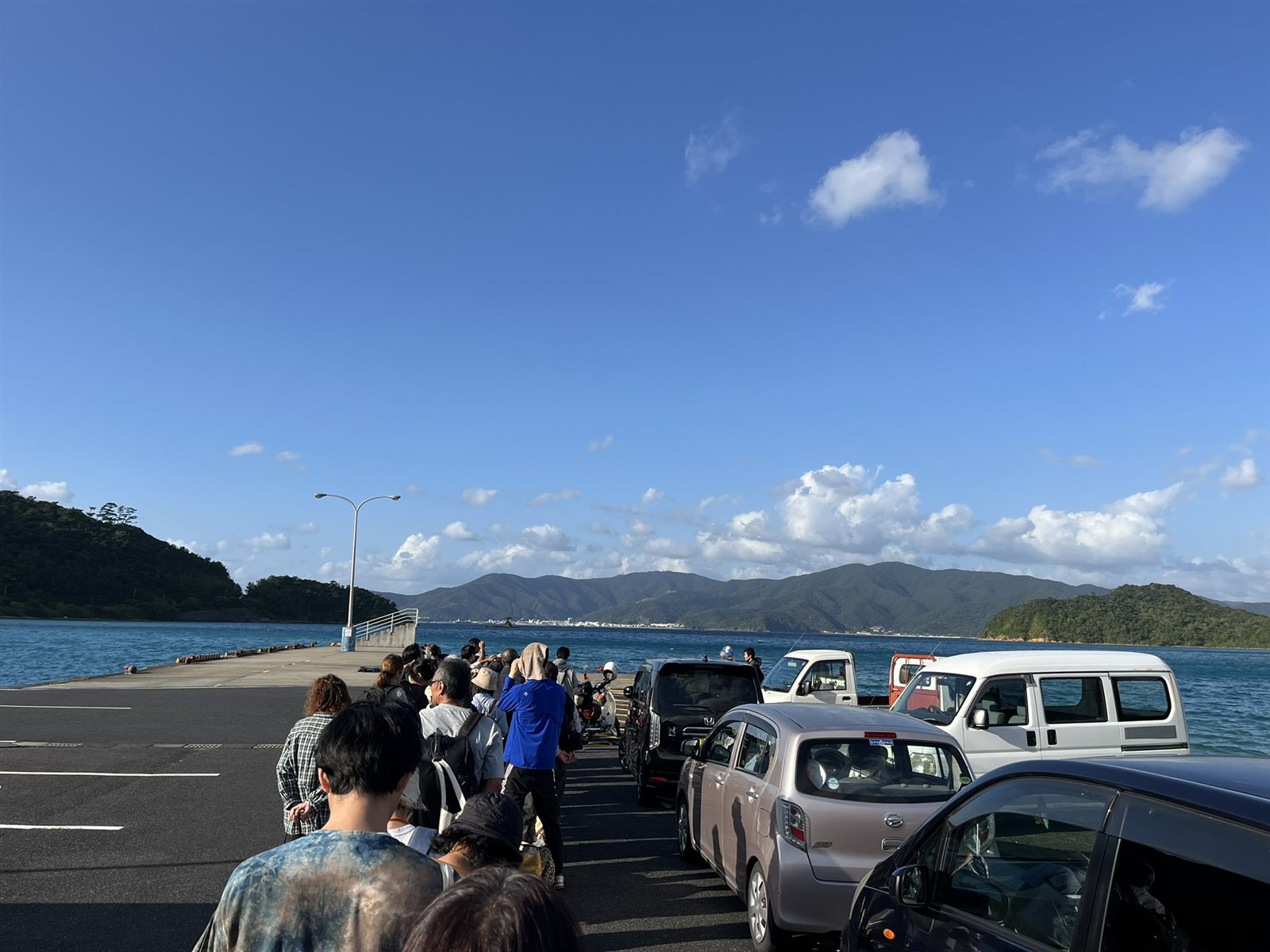
Shibaya is a performing art of the village festival. If you go to watch, please do not get in the way of the villagers running the event. On festival days, the town may issue notices about ferry use, so check in advance. On the festival day in 2025, a line of people waiting for the ferry formed at the port after it ended.
Opening days and hours of places to stay and eat may change. It is a good idea to book or call ahead for meals.
There are toilets and showers in the village, and parking space at the beachside park.
- Take your rubbish home with you
- Do not enter private homes or private land
- Do not climb the coral trees or break their branches
- Before going into the sea, check the tide and wave conditions
Shodon timeline
- End of the Heian period (late 12th century): Taira no Sukemori is said to have crossed to Shodon, built a castle and lived here
- Ryukyu Kingdom period: The coral tree flowers are said to have marked the trading port, and Ryukyu troops are said to have stayed near the avenue
- Early Meiji era: Shibaya, then with more than 20 pieces, stops after a failure on Tokunoshima
- Early Taisho era: Shibaya is revived at the opening ceremony of Shodon Elementary School
- 1943–1956: Shibaya stops again due to the hardships of the war and postwar years
- 1976: Shodon Shibaya is designated a National Important Intangible Folk Cultural Property
- 1978: The coral tree avenue is designated a Natural Monument of Setouchi Town
- 1995: The movie “Otoko wa Tsurai yo: Torajiro Kurenai no Hana” is released
- 2008: Erythrina gall wasp damage spreads to the avenue; all the coral trees in the village are treated
- 2020: Population of the Shodon district: 160 in 92 households (national census)
A village that has kept its play alive along the sea route
A village at the head of a bay, over the pass.
The legend of Taira no Sukemori, and Ochon Shrine where he is enshrined.
Shibaya, performed by men in paper masks and kept alive through two interruptions.
An avenue of 85 coral trees, said to have marked the sea route, and the white beach of Shodon Nagahama.
And the memories of people who walked over the pass and lived by helping one another.
Shodon’s history lies along the sea route linking south and north, and it lives on in the festival and the trees that the villagers still look after, and in a daily life of inns and shops.
To reach Kakeroma Island, take the Ferry Kakeroma from Koniya in the south of Amami Oshima. Ikenma is the closest port to Shodon. Timetable and fares:
Ferry Kakeroma Timetable and Fares | Koniya ⇔ Kakeroma Island (Seso / Ikenma)
Buses from Ikenma Port to Shodon:
Kakeroma Island Bus Timetables and Fares | 6 Routes and Ferry Connections
Tokuhama, over the pass from Shodon (in Japanese):
Ikenma, the village with the ferry port:
Ikenma: the eastern ferry port and the monument to the island song “Muchakana”


Comments